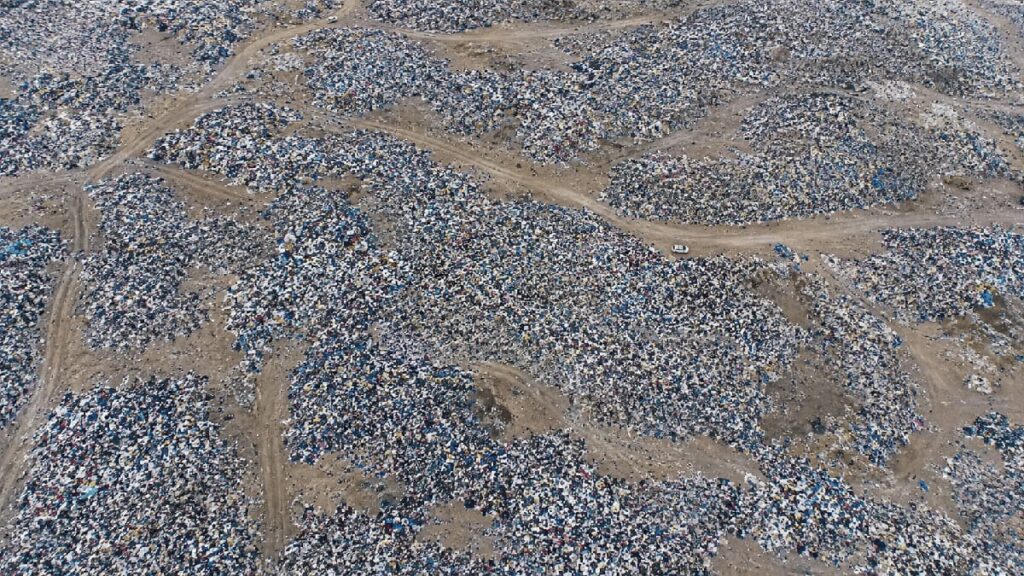
In the Atacama Desert, vast mountains of discarded clothing stretch across the landscape in piles so large they can be seen from space. Mismanaged textile waste is one of the fastest-growing environmental challenges of our time, driven by overproduction, synthetic materials, and a lack of circular design.
But beyond what we can see lies a more invisible, and arguably more insidious, problem: plastic leakage from textiles.
The Hidden Trail: Fashion’s Microplastic Footprint
A study by Cotton Incorporated estimates that the global apparel industry is responsible for 14% of total plastic leakage into the environment—around 8.3 million metric tons every year. To put that into perspective, that’s roughly the weight of over 800 Eiffel Towers.
Synthetic fibres, like polyester, nylon, and acrylic, contribute to this. Every time these materials are worn, washed, or discarded, they shed tiny fragments known as microplastics or synthetic microfibers.
These fibres can enter waterways through washing machines, travel through rivers into oceans, become airborne and settle in soil, food, and even our bodies. As many of us now know, microplastics have been detected everywhere — from deep ocean trenches to human bloodstreams.
What About Natural Fibres Like Cotton?
Cotton also sheds microfibres but there is a critical difference: cotton is biodegradable.
What does biodegradable actually mean?
A material is considered biodegradable if it can be broken down by microorganisms, such as bacteria and fungi, into natural elements like water, carbon dioxide, and biomass, without leaving harmful residues behind.
Unlike synthetic fibres, which can persist for hundreds of years, cotton fibres are part of a natural biological cycle.
Back to Earth: How Cotton Breaks Down
Scientific studies have shown that cotton can biodegrade relatively quickly under the right conditions. In fact, one study found that cotton fabric degraded faster than an oak leaf in an aquatic environment.
Typical biodegradation timelines for untreated cotton:
- Soil environments: weeks to months
- Marine environments: months (depending on conditions)
Compare that to synthetic fibres, which can persist for decades to centuries, fragmenting into ever-smaller microplastics along the way.
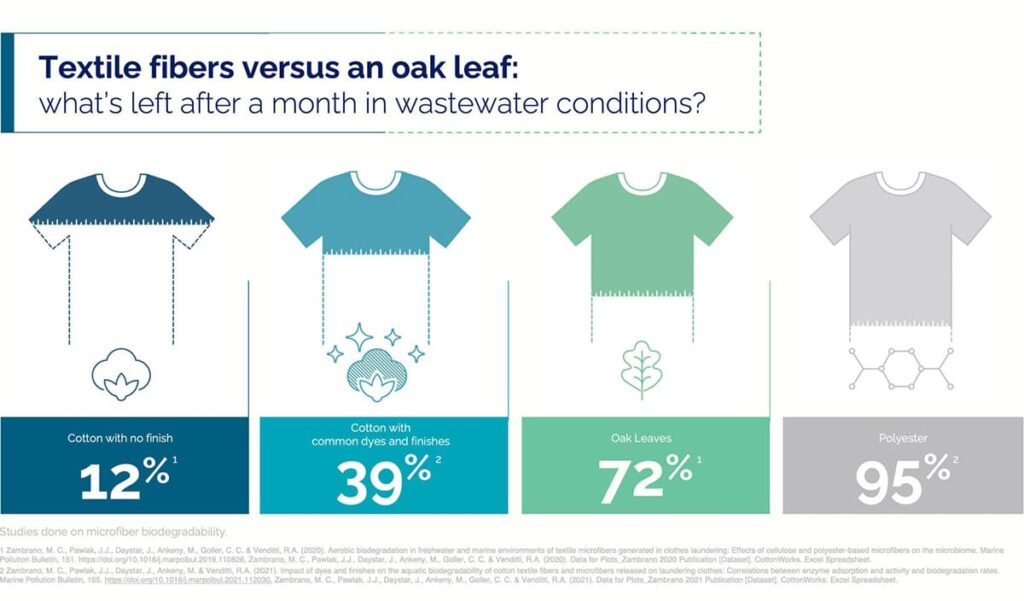
Study and image source: https://cottonworks.com/cotton-sustainability/biodegradability-of-cotton/
But Not All Cotton Is Created Equal
Here’s where things get more complex. The ability of cotton to biodegrade depends heavily on chemical finishes (wrinkle resistance, water repellents), dyes and treatments, and blends with synthetic fibres.
These can significantly slow down, or even prevent, natural decomposition.
Emerging research by Cary Sommers, “Natural” fibers in lakes: A 150-year sedimentary perspective on persistence, highlights this challenge. Her recent work points to key barriers to biodegradation in natural fibres, particularly linked to modern textile processing. Even basic plant and animal fibers can lose their ability to safely return to the earth if treated with persistent or toxic chemicals.
Fibre origin matters but so does everything that happens after harvest.
Designing for Return, Not Just Use
If we want textiles to truly return to the earth, we need to consider not only the material — but the entire system surrounding the material. This means:
- Choosing natural, renewable fibres
- Using safe, low-impact chemistry
- Avoiding unnecessary synthetic blends
- Designing for end-of-life from the start
At Organic Cotton Colours, this philosophy is embedded into every step of the process.
- Organically grown cotton without toxic pesticides
- Color-grown varieties, eliminating the need for synthetic dyes
- Minimally processed, preserving the fibre’s natural integrity
The result? Materials that are not only beautiful and functional, but also capable of returning safely to the soil.
A Different Ending for Our Clothes
The question is no longer just what are our clothes made from? It’s: what do they become after we’re done with them?
In a world overwhelmed by textile waste and microplastic pollution, the shift to circular design is necessary.
True regenerative fashion begins and ends with the soil.